
“Therefore, let us keep the feast!”- 1 Corinthians 5:8, The Apostle Paul
As the spring feasts are approaching, this post has been on my heart to write.
Although not widely known or celebrated in the Christian church, there are 7 beautiful feasts given to YHWH’s people in the Old Testament that point deeply and richly to Messiah and all that he has and will accomplish in the New. These feast days are called Moedim in Hebrew and mean “appointed time, place, or meeting.” God has used these appointed times all throughout scripture to do great things for his people, to meet with them and to provide for his chosen ones. The word moed also carries the implication of a dress rehearsal. Yah gave the feasts to his people as shadows of what was to come- salvation and deliverance through Yeshua our Messiah.
The feasts are broken up into two parts- the spring feasts and the fall feasts. The four spring feasts have all found their fulfillment in Christ’s first coming- in his sinless life, death, resurrection and in the giving of the Holy Spirit. Then there is a gap of time before the fall feasts, representing the time we are currently in- the time between Messiah’s first and second comings. The final three fall feasts have yet to be fulfilled and will be fulfilled when Messiah returns- the ingathering of Yah’s people, the Great White Throne Judgment and the Marriage Supper of the Lamb.
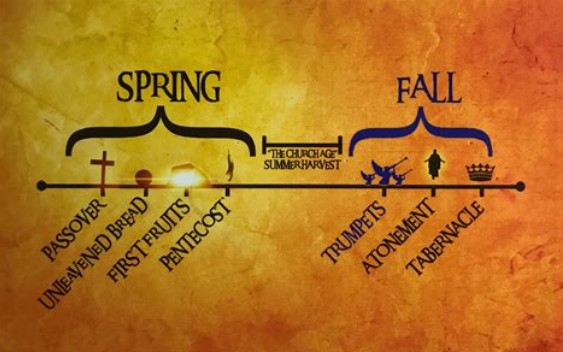
Passover begins the spring feasts and each year our understanding of this remembrance grows and our celebrations adjust. Passover is the beginning of the feast of Unleavened Bread. Passover celebrates God’s mighty hand and outstretched arm towards his people- saving them out of Egypt (which represents slavery to sin) and leading them into the Promised Land (the Kingdom of God- which has both already come and is also still yet to come in all its fullness). We celebrate that the blood of the perfect lamb (Yeshua) shed for us allows the just wrath of God to pass over us and keep us from death- not our earthly death but what is referred to as the second death- eternal death. Passover points primarily to the blood which Yeshua shed on the cross, which is also the bride price that he paid to enter into a new covenant with us.
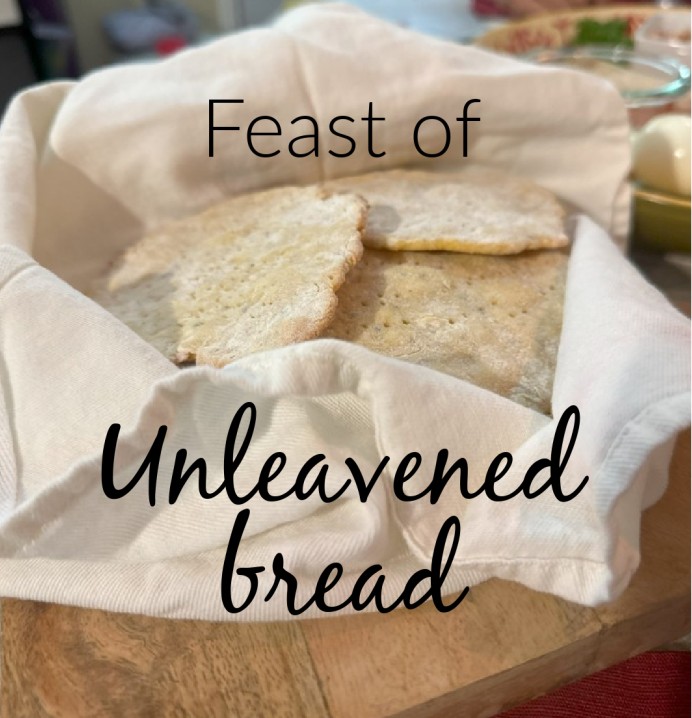
What follows is the feast of Unleavened bread.This seven-day feast is two-fold in its commands- we are to remove the leaven from our dwellings and eat unleavened bread for 7 days. Leaven clearly represents false teachings/traditions of men/sin in our lives throughout scripture. We are physically commanded to remove it and in doing so, we reflect on areas of our life where sin may be seeping in or taking hold. We clean our physical house as a representation of what we should be doing for our spiritual temple (our bodies)- cleaning house of anything taking our attention away from the Lord or leading us into sin.
The unleavened bread that we are to partake of represents Jesus in so many ways. He was the lamb of God- the perfect, blemish-free Passover lamb. When John the baptist saw Jesus, he declared, “Behold, the lamb of God who takes away the sins of the world” (John 1:29). Jesus himself declared in one of his many “I AM” statements that he was the bread of life (John 6:35). We are commanded to live like him and as his bride, to be sanctified and ready for his return. This is a time of reflection and of sanctification.
Within the feast of Unleavened Bread, we find the feast of Firstfruits following on the “morrow after the Sabbath” after the Passover. So this ALWAYS happens on the Sunday immediately following the Passover. When Jesus died, Firstfruits happened to fall three days and three nights after he was slain at the same time as the Passover lambs and yet before sundown. This is so overlooked by the church and makes me so sad. The typically held church timeline of Jesus’ death doesn’t add up to what he himself prophesied about his death and shows a gross misunderstanding of Yah’s appointed times. He was raised in order to present his firstfruits before YHWH as our high priest. And this offering had to be accepted before he could be touched (which is why he told Mary Magdalene in the garden that she couldn’t touch him because he hadn’t yet ascended to the Father, but Thomas COULD touch him after he’d presented the offering and it had been accepted). Firstfruits IS resurrection Sunday! Yah does nothing by accident! This was all planned from the beginning! 1 Corinthians 15:20 and 22 tells us this: “But Christ has indeed been raised from the dead, the firstfruits of those who have fallen asleep… For as in Adam all die, so in Christ all will be made alive. But each in his own turn: Christ the firstfruits; then, when he comes, those who belong to him.”
When YHWH first gave the command to celebrate firstfruits, it had to do with the barley harvest. The people weren’t allowed to partake of the new harvest until the firstfruits had been offered. In the same way, without Yeshua’s offering and being first among the resurrected, none of us would be able to follow. But he has indeed made a way!
Firstfruits points mostly to acceptance. God has accepted the terms of the marriage contract. Now Yeshua stands at the door and knocks (Revelation 3:20) waiting for us (the bride) to respond. Will we open up the door and accept Him?
The fourth feast is Shavuot, the feast of weeks, which believers know more commonly by its Greek translation- Pentecost. Pentecost literally translates as “weeks” because the people of YHWH were commanded to count 7 Sabbaths (weeks) from Firstfruits and then the following day was to be a feast unto the Lord. Pentecost is also known as the “festival of reaping” (since it comes at the barley harvest) or the “day of firstfruits” (the feast of Firstfruits was considered all the way until the end of these 50 days). This is traditionally when we recognize the Torah as being given on Mt. Sinai and as we see that the disciples gathered in the upper room, they were celebrating the same “set-apart” time that had been honored since the time of Moses! After the death and resurrection of Jesus we see a very special harvest- the harvest of 3,000 souls as can be found in Acts 2. We also see a strong connection with fire. Just as the all-consuming fire came down on the top of the mountain when Moses was receiving the 10 commandments, fire was what consumed the sacrifices, and fire can change the very nature of things being put in it (purification of metals, etc). Fire will also burn up the chaff at the end of the age. Fire in agriculture can make the land fertile- and it is continuing to purify the fields of our hearts and make them able to yield much fruit! During Shavuot, the priest is to wave two barley loaves before the priest- these represent both Israel and the ecclesia, more commonly known as the church- both being the called-out, set-apart people of YHWH. We also see the giving of the 10 commandments in stone vs. the commandments being written on our hearts (as prophesied in Jeremiah 31:33). We are now empowered to obey YHWH by the Holy Spirit, the revealer of truth!
I will do another post closer to the fall feasts. These are the feasts which will be fulfilled at our Messiah’s second coming and these are ones that we practice in anticipation for what is yet to come.
Therefore, my friends, as Paul said, “let us keep the feasts!”



 Logsdon's big adventures!
Leave a comment